- Pakistan all set to be connected with rest of the world by year end via China’s Digital Silk Route land and submarine cable network
- Initiated under Belt and Road Initiative, the high-speed, 15,000 km subsea cable system will offer high-capacity, low-latency routes connecting China, Europe and Africa
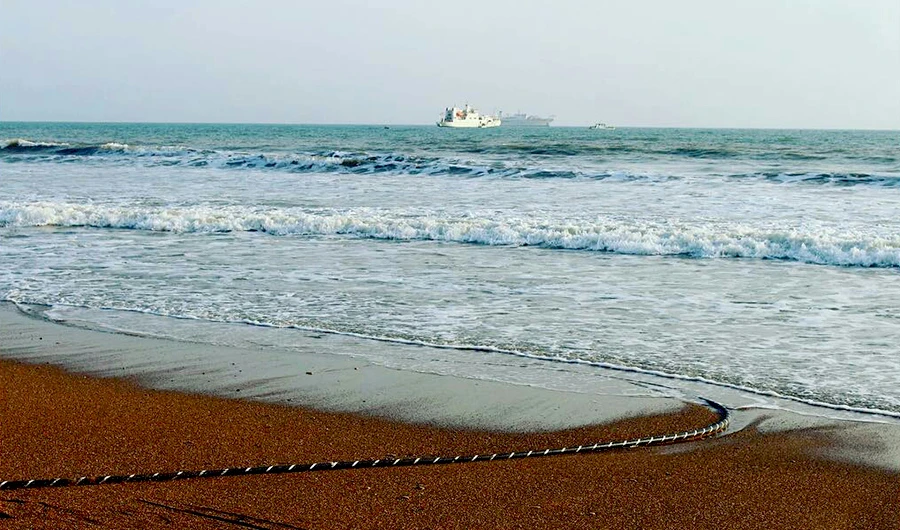
KARACHI: Pakistan is all set to be directly connected with the rest of the world by the end of this year via the Digital Silk Route (DSR), a land and submarine cable network initiated by China under its Belt and Road Initiative (BRI), Pakistani officials said, with cable deployment work on the most vital final link that will connect Karachi, Pakistan, with Zafarana, Egypt, to start next month.
The network, called the Pakistan and East Africa Connecting Europe (PEACE), is a high-speed, 15,000 km subsea cable system that will offer high-capacity, low-latency routes connecting China, Europe and Africa. In addition to France, the cable will land in Malta, Cyprus, Egypt, Djibouti, Kenya, Pakistan and other countries and regions, with onwards terrestrial connectivity to China.
A majority of the work on the project has been completed, a top official in charge of the project told Arab News on Monday.
“All approvals have been granted by the government,” said Maroof Ali Shahani, Chief Operating Officer of Cybernet, the cable landing partner for PEACE in Pakistan, said. “Work on the deployment of cable will start in March (2021).”
“Everything is on track. The work on the cable landing station is already underway in Karachi,” Shahani said adding: “The project is slated to be completed in the fourth quarter of the current year.”
The cable will be laid in the Arabian Sea by a consortium comprising telecom companies from Pakistan, Africa, France, Egypt, and Hong Kong. The consortium is headed by the Hengtong Group, China’s leading cable manufacturer.
The PEACE cable in Pakistan will be connected with the China-Pakistan Cross Border Fibre Optical Cable which has already been completed under the China Pakistan Economic Corridor (CPEC) initiative. The fiber optic cable, covering an area of 820 km, connects China with Pakistan through Gilgit Baltistan, Khyber Pakhtunkhwa, and Punjab. It was completed back in 2018 at a cost of $37.4 million. The existing terrestrial network will be utilized to connect the cable with PEACE in Sindh for onward link, according to official documents.
In November 2020, the first cable loading for the Mediterranean Segment (PEACE Med) was successfully achieved and work on the Egypt-France route was started.
In the first phase, PEACE will connect the three most populated continents in the world and provide critical interconnection to the economic corridors of Asia, Europe, and Africa.
A total capacity of 96 Tbps (terabits per second) will be added to Pakistan’s Internet infrastructure through the project, officials said. The round trip delay between Karachi and Marseilles (Pakistan-France) would be 89 millizecond.
“PEACE is offering better speed, better capacity and giving direct route,” Pervaiz Iftikhar, a member of the prime minister’s task-force on IT and Telecom, told Arab News. “Since it is direct it means latency, the time for the flow of data will be less.”
“It [PEACE] would drastically improve the data transmission performance and help to accelerate digital transformation in the participating nations on an unprecedented scale,” said Dr. Muhammad Khurram Khan, the founder and CEO of the Global Foundation for Cyber Studies and Research in Washington DC.
However, he warned that global reliance on submarine cables could exacerbate cybersecurity concerns.
“Though such cables have very strong resilience against accidental or natural damages,” Khan said, “but risks associated with cyberattacks, data theft, and sabotage by state and non-state actors should never be overlooked.”